
In this post, we speak to the authors of a recent PLOS Global Public Health article, “Crises are a perpetual restart” – a comparative…
The “Why, why, why” of tuberculosis – Why storytelling is integral to the fight against TB
By guest contributor Leslie Enane
As public health leaders, researchers, clinicians, and advocates in the fight against tuberculosis (TB) gathered in Copenhagen at the annual Union World Conference on Lung Health this November, they rallied around a new, much-needed realm to this fight – one led by the storytellers.
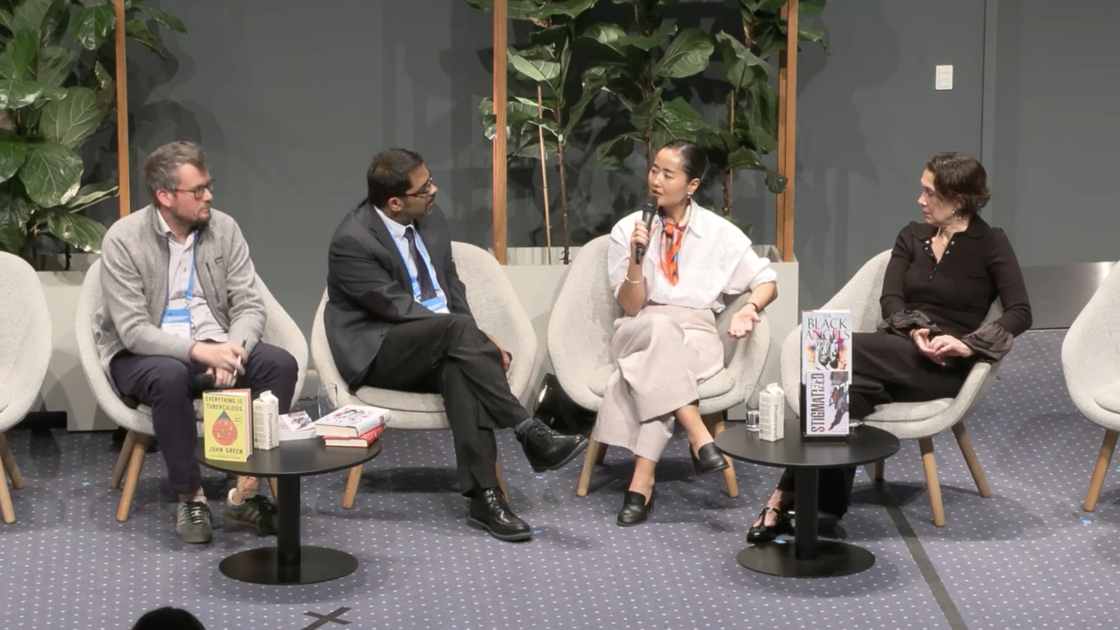
In a spotlight session titled “Tuberculosis – New warriors take on an old enemy,” chaired by Madhukar Pai, Chair of the Department of Global and Public Health at McGill University, and based on his blog post by the same name, four authors shared their paths to writing essential books about TB. They are Vidya Krishnan, author of Phantom Plague: How Tuberculosis Shaped Our History; Handaa Enkh-Amgalan, author of Stigmatized: A Mongolian Girl’s Journey from Stigma & Illness to Empowerment; John Green, author of Everything is Tuberculosis: The History and Persistence of Our Deadliest Infection; and Maria Smilios, author of The Black Angels: The Untold Story of the Nurses who Helped Cure Tuberculosis. In a stark example of visa injustice, Vidya Krishnan – an award-winning journalist with decades of experience in global health – was denied a visa to attend the meeting in Denmark and instead shared her videotaped remarks.
“A disease is not just a biomedical phenomenon; it’s also the stories we tell about it.” – John Green
Despite being curable and preventable for several decades, TB remains the leading infectious cause of death by a single pathogen. Over 10.7 million people fell ill with TB in 2024, and over 1.2 million people lost their lives. TB is a complex and serious illness. It can be difficult to recognize and to diagnose; it requires a prolonged course of treatment with multiple medications which can be intolerable; and many survivors suffer from poor lung health and other sequelae. Yet the persistence of TB as a global killer largely owes to the persistence of poverty, injustice, and indifference.
In the session, each author spoke about their motivations to write about TB and to become advocates. They spoke about ways in which the echoes of the remarkable histories of TB still resonate in the present-day tragedies and inequities of this disease. Throughout each of their works, we see the intertwined effects of stigma and ignorance, racism and colonialism, poverty and injustice, in perpetuating TB.
“The history of tuberculosis matters. If we don’t know the history of something, we will never be able to fix it.” – Maria Smilios
The story of TB and its impact are unfortunately largely invisible to those who are not affected by it, and that is part of the problem. Most people in countries with low TB incidence have likely been unaware that TB is the leading infectious disease killer in the world. But with these new books that have broken into popular culture and mass media, awareness is changing. And with it, new voices, ideas, and resources can hopefully be brought into this fight.
“I chose storytelling to be a form of resistance towards stigma. … If, as human beings, we can create stigma, we can also un-create it.” – Handaa Enkh-Amgalan
As important as increasing awareness has been, equally essential is the elucidation of narratives and meaning. In his book, John Green points to a passage in Kurt Vonnegut’s Cat’s Cradle, about our basic need for meaning:
Tiger got to hunt, bird got to fly;
Man got to sit and wonder ‘why, why, why?’
Tiger got to sleep, bird got to land;
Man got to tell himself he understand.
This need for meaning-making and storytelling may help explain why an auditorium full of people working against TB was fully captivated by these authors. Dr. Pai remarked that the session served as a “group therapy session” of sorts, only partly joking. For people working in TB and in other areas of global health, it has been an incredibly difficult year. The abrupt drawback of global health funding and support has already cost many thousands of lives. Critical organizations and infrastructure for lifesaving aid, which took decades to build, were eliminated overnight. Research teams across the world lost funding, and clinical trials were disrupted. In this destruction, while there is hope that more resilient and equitable foundations for global health can be re-imagined and re-built, at present, it can be hard to feel optimistic.
“Literature helps me make meaning of this casual cruelty that walks hand in hand with failing health systems. It is in literature that I find everything that is missing in our policies – inspiration, intuition, and courage to imagine a new world.” – Vidya Krishnan
In this disorienting situation, stories and narratives are essential. We need to tell the story about our collective human fight against Mycobacterium tuberculosis, one that centers the survivors, nurses, clinicians, and public health workers on the “front lines.” As Albert Camus wrote in The Plague, we must “refuse to be on the side of the pestilence.” Through narratives we resist the ways in which people with TB (or other conditions) are stigmatized and discriminated against. We resist the idea that scientists, clinicians, or public health practitioners are “the enemy.” And we resist disinformation that has been used to dismantle lifesaving aid and research.
The power of storytelling is in telling the truth. George Orwell wrote his classic 1984 as he was dying of TB, just a few years before the advent of curative treatment. Ever more prescient, his allegory takes disinformation and authoritarianism to their dark conclusion. But we can see that in dark times, there is real light, humanity, and community in sharing powerful stories.
About the author:

Leslie Enane, MD, MSc, FAAP is an Associate Professor of Pediatrics in the Ryan White Center for Pediatric Infectious Disease and Global Health and the Department of Pediatrics at Indiana University School of Medicine.